At Help for Thesis, we provide specialized coding support to help PhD scholars, doctoral candidates, and master's researchers transition seamlessly from theoretical proposals to fully functioning, committee-ready Python implementations.
| Service | Review paper writing and review article development |
| Suitable for | PhD scholars, research faculty, journal authors, PG students |
| Review types | Narrative, systematic, scoping, meta-analysis, critical, integrative |
| Research areas | Engineering, computer science, AI, medicine, management, social sciences |
| Literature sources | IEEE Xplore, Scopus, ScienceDirect, SpringerLink, PubMed, Google Scholar |
| Reference styles | APA, MLA, IEEE, Chicago, Harvard, Vancouver, AMA, or university format |
| Similarity threshold | Under 8% — Turnitin report provided |
| Delivery | 20 working days · timeline confirmed before work begins |
| Revisions | Unlimited |
| Deliverables | Review document, reference file, editable figures, plagiarism report |
| Confidentiality | Work is exclusive to you and never reused |
| Contact | +91 7200035629 · WhatsApp |
Python implementation for research is the technical process of converting academic methodologies, algorithms, base paper pseudocode, and mathematical models into executable, testable, and reproducible Python code that produces verified experimental results for a thesis or dissertation.
From base papers or your own design.
Classification, regression, clustering.
CNN, RNN, LSTM, transfer learning.
Preprocessing, EDA, statistics.
Decision logic & predictive systems.
Fixing errors, restoring expected output.
We specialize exclusively in academic and doctoral-level implementation, combining deep domain knowledge across four core technical pillars:
Converting complex mathematical equations, pseudocode, and base paper methodologies into custom, optimized Python scripts.
End-to-end model development using PyTorch, TensorFlow, Keras, and Scikit-learn for classification, regression, and sequence modeling.
Handling missing values, feature scaling, high-dimensional data processing (NumPy/Pandas), and generating publication-ready charts (Matplotlib/Seaborn).
Real-world examples demonstrating how we convert theoretical methodologies into functional research code:
Objective: Implement a multi-stage neural network for early arrhythmia detection using raw ECG data streams.
Execution: Preprocessed noise using SciPy filters, built spatial feature extractors via 1D CNNs, and captured temporal dependencies using dual LSTM layers in PyTorch. Achieved a 98.2% F1-score for dissertation evaluation.
Objective: Re-implement and adapt a metaheuristic scheduling algorithm from a baseline IEEE paper.
Execution: Coded custom crossover and adaptive mutation operators in Python to resolve multi-objective energy-latency trade-offs in cloud data centers, generating baseline comparison charts using Matplotlib.
Objective: Extract nuanced social sentiment across regional language text datasets.
Execution: Combined HuggingFace Transformers (BERT fine-tuning) with spaCy and NLTK for text normalization, TF-IDF vectorization, and BERTopic clustering, delivering structured evaluation metrics for chapter presentation.
In an academic setting, Python implementation covers the full technical path from a written methodology to a set of research results. This typically includes:
— taking the steps described in a proposal or paper and expressing them as a program.
— coding the logic of an existing, modified, or newly proposed algorithm.
— cleaning, transforming, and preparing data so it is usable by the implementation.
— building the model architecture and training pipeline required by the research design.
— running the implementation under different conditions or parameter settings.
— modeling a process or system computationally when physical testing isn't feasible.
— measuring performance using appropriate metrics.
— producing the numbers, tables, and outputs that support the thesis argument.
— turning results into charts and graphs suitable for a thesis or paper.
—structuring the code and documentation so the work can be re-run and verified.
Each of these stages depends on the one before it. A dataset that isn't properly prepared will produce misleading evaluation results; an algorithm that isn't implemented correctly will produce results that don't match the research question. This is why implementation is usually treated as its own distinct phase of research work, separate from writing the proposal or the thesis document itself.
Python implementation is the process of writing Python code that executes a specific algorithm, model, or research methodology and produces measurable, evaluable results.
It is the practical, technical counterpart to the conceptual or theoretical part of a research project.
Python Programming
Python Implementation
Python Project Development
Python Algorithm Implementation
Python Research Implementation
It helps to separate a few terms that are often used loosely:
| Term | What It Means |
|---|---|
| Python programming | Writing code in Python generally — this could be anything from a simple script to a full application. |
| Python implementation | Coding a defined methodology, algorithm, or model so that it functions and produces results consistent with a research objective. |
| Python project development | Broader still, and can include implementation plus additional work such as interface design, deployment, or integration with other systems. |
| Python algorithm implementation | A narrower case of implementation focused specifically on coding an algorithm's logic — for example, implementing a published clustering algorithm exactly as described, or with modifications. |
| Python research implementation | Implementation done in an academic research context, where the code must align with a methodology chapter, be explainable in a viva or defense, and produce results that can be discussed and interpreted. |
Example: A student proposing a modified k-means clustering algorithm for customer segmentation needs the algorithm coded in Python (algorithm implementation), applied to a specific dataset (research implementation), and possibly visualized in a simple dashboard (project development) — three related but distinct pieces of work that together make up the implementation phase of the thesis.
Python has become a common choice for academic and research implementation work for several practical reasons:
Python code is comparatively easy to read and explain, which matters when a student needs to walk a supervisor or committee through their implementation.
A wide range of libraries exist for nearly every research task, from numerical computing to natural language processing.
Libraries like Pandas and NumPy make data handling and manipulation straightforward.
Scikit-learn and similar libraries provide tested, well-documented implementations of standard algorithms.
TensorFlow, Keras, and PyTorch support building and training neural networks without writing low-level code from scratch.
Matplotlib, Seaborn, and related tools make it possible to generate publication-style graphs directly from results.
Libraries such as SciPy support statistical and mathematical operations common in research.
Python's interactive tools (like Jupyter notebooks) allow researchers to test ideas incrementally rather than rewriting large programs for each change.
Python code can generally interface with databases, APIs, and other software components fairly easily.
Repetitive tasks such as running an experiment across multiple parameter settings can be scripted.
Combined with tools like Anaconda, Python environments can be documented and shared so results can be reproduced.
We provide implementation support across the stages a research project typically requires. Depending on your project, this can include:
Reviewing your topic to understand the technical implementation it will require.
Helping translate a research question into a well-defined computational problem.
Coding algorithms from base papers, with or without modification.
Writing original code for methodologies that don't map to an existing algorithm.
Cleaning, normalizing, and structuring datasets for use.
Selecting and constructing input variables for models.
Building classification, regression, or clustering pipelines.
Building and training neural network architectures.
Implementing broader intelligent-systems components such as decision logic or recommendation mechanisms.
Image processing, object detection, and related tasks.
Text preprocessing, language models, and related NLP pipelines.
Descriptive and inferential analysis of research data
Generating charts, plots, and figures for the thesis.
Applying appropriate metrics to measure performance.
Running controlled experiments and parameter comparisons.
Identifying and resolving errors in existing code.
Improving runtime or memory efficiency where needed.
Explaining code structure, dependencies, and how to run it.
Helping you understand what your output numbers mean in context of your research question.
Walking through the implementation so you can explain it confidently.
Python implementation plays a role at different stages across doctoral and thesis research, and the specific technical needs vary significantly by field. Some representative examples:
Implementing and benchmarking algorithms, building prototype systems.
Coding decision-making models, search algorithms, or intelligent agents.
Building and comparing predictive models on research datasets.
Developing end-to-end pipelines from raw data to insight.
Implementing systems-level components or network simulations.
Signal processing scripts and sensor data analysis.
Modeling and simulating communication protocols or signal behavior.
Processing sensor-generated data streams and implementing edge-analytics logic.
Implementing detection algorithms and simulating attack/defense scenarios.
Analyzing clinical or health datasets and implementing diagnostic-support models.
Sequence analysis and biological data processing pipelines.
Filtering, segmentation, and feature extraction from image data.
Text classification, sentiment analysis, and language model fine-tuning.
Implementing control logic or simulation environments.
Scripting resource management or performance-testing tools.
Implementing rule-based or model-driven automation logic.
Each of these areas draws on a different combination of Python libraries and techniques, which is why the first step in any engagement is understanding your specific research requirements before recommending an approach.
A large share of thesis and PhD implementation work centers on algorithms — coding them, adapting them, and comparing them against alternatives. This can involve:
Implementing a published algorithm as described in its original form.
Coding an algorithm the researcher has designed themselves.
Adapting an existing algorithm with changes proposed in the research.
Combining two or more existing techniques into a new approach.
Genetic algorithms, particle swarm optimization, and similar methods.
Decision trees, support vector machines, neural classifiers, and others.
K-means, hierarchical clustering, DBSCAN, and variants.
Regression-based and time-series forecasting methods.
Simulated annealing, ant colony optimization, and related approaches.
The general process runs from specification to evaluation: first, the algorithm's logic is precisely understood (often from pseudocode or mathematical notation in a base paper); then it's translated into Python, tested on sample data to confirm it behaves as expected, applied to the actual research dataset, and finally evaluated and compared against baseline or alternative methods. Each step is checked against the original specification so the implementation stays faithful to what the research claims to be testing.
Machine learning implementation for research generally follows a structured pipeline:
Data
preprocessing
Train/test
splitting
Feature
engineering
Classification
Regression
Clustering
Dimensionality
reduction
Ensemble
learning
Hyperparameter
tuning
Model
evaluation
Comparison
of models
Visualization
Data preprocessing — handling missing values, encoding categorical variables, scaling features.
Train/test splitting — dividing data appropriately, including techniques like k-fold cross-validation.
Feature engineering — creating or selecting the variables that go into the model.
Classification — assigning data points to categories.
Regression — predicting continuous outcomes.
Clustering — grouping data without predefined labels.
Dimensionality reduction — techniques like PCA to simplify high-dimensional data.
Ensemble learning — combining multiple models, such as random forests or boosting methods.
Hyperparameter tuning — systematically testing parameter combinations to improve performance.
Model evaluation — accuracy, precision, recall, F1-score, and other relevant metrics depending on the problem.
Comparison of models — testing multiple algorithms against the same dataset to identify the best fit for the research question.
Visualization — plotting confusion matrices, ROC curves, feature importance, and other diagnostic charts.
This work commonly draws on NumPy for numerical operations, Pandas for data handling, Scikit-learn for model implementation, and Matplotlib or Seaborn for visualizing results — though the right combination depends on the specific dataset and research goal.
Deep learning implementation typically involves designing and training neural network architectures suited to the research problem, including:
Neural networks — standard feedforward architectures for structured data.
CNN (Convolutional Neural Networks) — commonly used for image-based tasks.
RNN (Recurrent Neural Networks) — for sequential data such as time series or text.
LSTM (Long Short-Term Memory networks) — for sequences with longer-term dependencies.
GRU (Gated Recurrent Units) — a lighter-weight alternative to LSTM for sequence modeling.
Transfer learning — adapting pretrained models to a new research dataset.
Image classification — assigning labels to images based on learned features.
Object detection — identifying and localizing objects within images.
Sequence modelling — for tasks like language modeling or forecasting.
Deep learning experimentation — testing different architectures, layer configurations, and training strategies.
This work commonly uses TensorFlow, Keras, or PyTorch. Each framework has its own strengths and typical use cases — Keras is often used for quicker prototyping, PyTorch is common in research settings that need more architectural flexibility, and TensorFlow is widely used in both research and production contexts. No single framework is universally the best choice; the right one depends on your specific model, the resources available, and sometimes on conventions already established in your research area or supervisor's lab.
Beyond standard machine learning and deep learning pipelines, AI research implementation can involve building components for:
— rule-based or learning-based decision logic.
— forecasting outcomes based on historical data.
— suggesting items based on user behavior or content similarity.
— extracting meaning or structure from text.
— interpreting visual data.
— identifying unusual patterns in data, often used in fraud detection or fault monitoring.
— scripting decision logic that reduces manual steps in a process.
— combining data analysis and modeling to support human decision-making.
AI research projects often combine several of these elements — for example, a smart healthcare monitoring system might involve anomaly detection on sensor data plus a predictive model for risk scoring plus a simple recommendation layer for suggested actions.
Even research that doesn't involve machine learning still typically requires structured data analysis implementation, covering:
Data collection — organizing raw data from surveys, sensors, logs, or public datasets.
Data cleaning
— removing duplicates, correcting errors,
standardizing formats.
Missing-value handling — imputation or exclusion strategies appropriate to the dataset.
Transformation — normalizing, scaling, or reshaping data for analysis.
Exploratory data analysis (EDA) — summarizing data through descriptive statistics and visual inspection.
Statistical analysis — hypothesis testing, correlation, regression, and other inferential technique.
Visualization — histograms, scatter plots, box plots, and other charts appropriate to the data type.
Correlation analysis — examining relationships between variables.
Feature analysis — understanding which variables are most relevant to the research question.
Reporting — organizing results into tables and figures suitable for a thesis chapter.
This is often the foundation that later modeling work is built on — analysis quality has a direct effect on how trustworthy the subsequent implementation results will be.
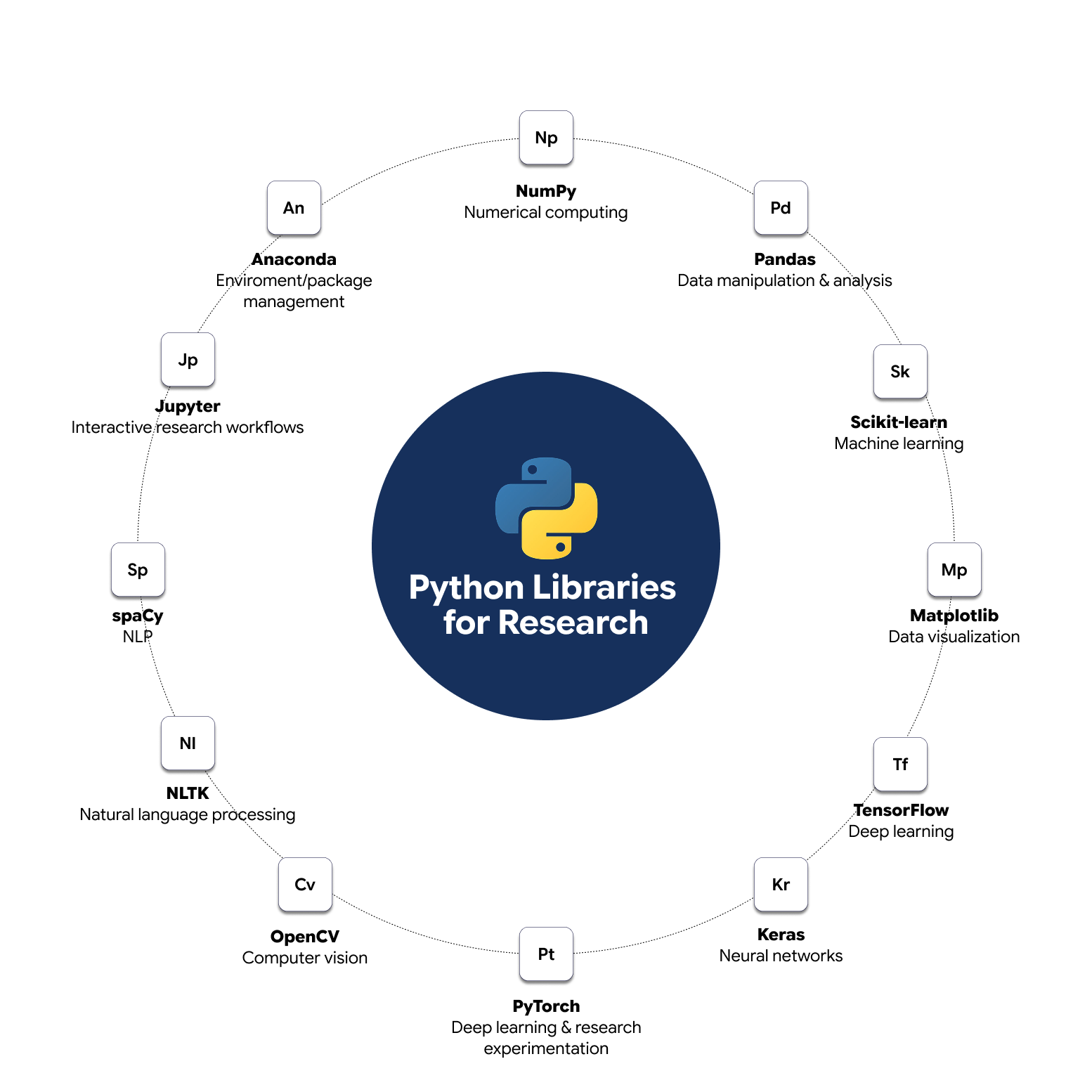
Not every tool is appropriate for every project — a text-classification thesis has little use for OpenCV, and a computer vision project won't typically need NLTK. Part of our process is identifying which specific libraries actually fit your research problem rather than defaulting to a standard list.
Our general approach to a Python implementation engagement follows these steps:
Reviewing your topic, objectives, and any existing documentation.
Understanding what existing work your project builds on or departs from.
Clarifying exactly what the code needs to demonstrate or measure.
Matching methods and libraries to your specific research question.
Sourcing, cleaning, and structuring the data required.
Writing the core code for the methodology or algorithm.
Checking the implementation behaves correctly on known cases.
Running training cycles and validation for ML/DL work.
Producing the output data, metrics, and figures.
Benchmarking against baselines or alternative approaches where relevant.
Improving speed, memory use, or accuracy where feasible.
Recording what was done, how, and why, so it can be reproduced.
Walking through the code and results so you understand and can defend the work.
This sequence is adapted depending on your project's scope — a small algorithm-comparison study looks different from a full deep learning pipeline with multiple experiments, but the underlying structure of requirement-to-result stays consistent.
Implementing decision-making logic, search algorithms, or knowledge-based systems tied to a specific research question.
Building and comparing classification, regression, or clustering models on research datasets.
Designing and training neural network architectures for tasks such as classification or sequence prediction.
End-to-end pipelines covering collection, cleaning, analysis, and visualization.
Image preprocessing, feature extraction, object detection, and classification tasks.
Text preprocessing, sentiment analysis, topic modeling, and language-based classification.
Processing and analyzing sensor-generated data streams and implementing basic edge-analytics logic.
Implementing intrusion-detection logic, simulating and analyzing attack patterns.
Analyzing clinical datasets, implementing models to support diagnosis-related research (as a technical exercise, not a clinical tool).
Sequence analysis, genomic data processing, biological pattern detection.
Filtering, segmentation, enhancement, and feature extraction from image datasets.
Forecasting models applied to business, environmental, or scientific data.
Collaborative or content-based filtering implementations.
Control logic and simulation environments for robotic behavior.
Rule-based or model-driven automation for smart-home, smart-grid, or similar applications.
Depending on the scope of your project, deliverables can include:
Python source code
Organized project structure
Requirements/dependency information (e.g., a requirements file listing needed libraries)
Dataset preprocessing scripts
Trained model files, where applicable
Jupyter notebooks, where useful for demonstrating the workflow
Configuration files
Result files
Graphs and charts
Summary tables
Evaluation metrics
Technical documentation explaining the implementation
Execution instructions
Debugging support during review
A walkthrough explaining how the implementation works
Not every project requires every item on this list — a statistical analysis project, for example, won't involve trained model files, while a deep learning project may not need extensive dataset-preprocessing scripts if the data is already clean. We confirm the applicable deliverables with you before starting.
Reliability in research code comes from a consistent process rather than any single guarantee:
Requirement validation — confirming the implementation objective matches your methodology before coding begins.
Modular coding — structuring code into clear, testable components rather than a single unmanageable script.
Testing — checking the implementation against known inputs and expected behavior.
Debugging — resolving errors identified during testing or review.
Dataset validation — checking data quality and structure before it's used in analysis or modeling.
Reproducibility — documenting steps and dependencies so results can be regenerated.
Parameter documentation — recording the settings used so results can be explained and, if needed, adjusted.
Performance evaluation — applying appropriate metrics rather than relying on a single number.
Result verification — sanity-checking outputs against expectations from the methodology.
Version/environment management — recording library versions and environment details to avoid compatibility issues later.
This process reduces the likelihood of errors and improves the credibility of the implementation, but no research code — from any provider — can be claimed as completely error-free. Our aim is a rigorous, well-documented, and explainable implementation rather than an unrealistic guarantee.
Researchers implementing their own methodology, or reviewing implementation support, frequently run into the same set of obstacles:
A proposal or paper that doesn't fully specify how a step should work in code.
Converting notation from a paper into correct, working logic.
Version mismatches between packages required by different parts of a project.
Installation or environment issues that prevent code from running.
Data that is incomplete, inconsistent, or not representative of the research question.
Gaps that need to be handled carefully to avoid biasing results.
Models that perform well on training data but poorly on new data.
Datasets where one category dominates, skewing model performance.
Implementations that take too long to run, particularly with large datasets or deep learning models.
Hardware constraints that limit dataset size or model complexity.
Using metrics that don't actually reflect what the research question is asking.
Code that produces different results on different runs or machines.
Implementation support addresses these by applying a structured process — clarifying requirements up front, validating data before use, testing incrementally, and documenting decisions — so problems are caught early rather than discovered late in the research timeline.
| Requirement | Python | MATLAB | R | Java |
|---|---|---|---|---|
| Machine learning / deep learning libraries | Extensive (Scikit-learn, TensorFlow, PyTorch) | Available via toolboxes, often licensed | Available (caret, mlr) but smaller ML ecosystem | Limited, fewer research-oriented ML libraries |
| Statistical analysis | Good, via SciPy/statsmodels | Strong, especially for engineering-style analysis | Very strong, purpose-built for statistics | Not a typical choice for statistical work |
| Signal processing / control systems | Supported via libraries | Strong, widely used in engineering research | Limited | Limited |
| Data visualization | Strong (Matplotlib, Seaborn) | Strong, built-in plotting | Strong (ggplot2) | Requires external libraries |
| Learning curve | Moderate, widely taught | Moderate, common in engineering curricula | Moderate, common in statistics curricula | Steeper for research prototyping |
| Community/library support | Very large, active | Large but often licensed | Large in statistics community | Large but less research-focused |
| Cost | Free and open-source | Typically requires a paid license | Free and open-source | Free and open-source |
Tool choice should be driven by the research objective, not by the popularity of a language. MATLAB remains common in signal-processing and control-systems research; R is often preferred for statistics-heavy social science or biostatistics work; Java appears in some systems-oriented or enterprise-adjacent research. Python is frequently chosen for its combination of general-purpose flexibility and strong machine learning/deep learning support, but it isn't automatically the correct choice for every research area.
PhD scholars working on algorithm-heavy or data-driven dissertations.
Doctoral researchers who need to implement or benchmark methods described in their proposal.
Master's students completing a thesis with a technical implementation component.
Research scholars publishing papers that require reproducible code.
Academic researchers working on funded or collaborative projects with a coding component.
Faculty researchers who need implementation support alongside teaching and supervision duties.
R&D teams translating research concepts into working prototypes.
Researchers converting algorithms into prototypes for demonstration or further development.
Unlike commercial software agencies, our technical support is engineered strictly around doctoral defense and academic peer-review standards:
We supply clean Anaconda .yml or requirements.txt environment configurations alongside Jupyter Notebooks, ensuring your scripts run smoothly during live committee demonstrations.
Every model includes rigorous validation benchmarks—such as k-fold cross-validation, confusion matrices, ROC-AUC curves, and RMSE—matching peer-reviewed journal requirements.
We don't just hand over code. We conduct interactive walkthrough sessions explaining algorithm architecture, variable definitions, and hyperparameter tuning so you can confidently defend your work in a viva.
Your datasets, custom algorithm variations, and final scripts remain 100% your intellectual property, protected under strict non-disclosure workflows.
Get in touch today for a free consultation with one of our implementation experts. Tell us about your topic, and we will tell you how we can implement it and give you 100% accurate techniques.
Python implementation is the process of writing Python code that executes a specific algorithm, model, or methodology and produces measurable results. It's the technical step that turns a described process — whether from a research proposal, a published paper, or a designed system — into a program that actually runs and can be tested.
In a research context, Python implementation means coding the methodology described in a thesis or paper so it produces results that can be evaluated and discussed. This includes implementing algorithms, processing datasets, building models where applicable, and generating the outputs — tables, graphs, metrics — that support the research argument.
Yes. We support PhD scholars across stages of doctoral research that require Python implementation, including algorithm coding, machine learning and deep learning model development, data analysis, and documentation of the technical work for review or defense.
Yes. We can implement algorithms described in a base paper, whether as originally specified or with the modifications your research proposes. This typically involves interpreting pseudocode or mathematical notation, coding it, testing it, and comparing its output against expected or baseline results.
Yes, if your research involves an algorithm you've designed yourself rather than one from existing literature, we can help implement it based on your specification, then test and refine it against your research objectives.
Yes. Python is widely used for machine learning research due to libraries like Scikit-learn, which provide well-tested implementations of standard algorithms for classification, regression, and clustering, along with tools for evaluation and comparison.
Yes. We work with frameworks such as TensorFlow, Keras, and PyTorch to build and train neural network architectures, including CNNs, RNNs, LSTMs, and transfer-learning approaches, depending on what your research requires.
Common libraries include NumPy and Pandas for data handling, Scikit-learn for machine learning, TensorFlow/Keras/PyTorch for deep learning, Matplotlib/Seaborn for visualization, OpenCV for computer vision, and NLTK/spaCy for NLP. The right combination depends on your specific research area.
Yes. Dataset preprocessing — cleaning, handling missing values, transforming and structuring data — is typically one of the first practical steps in implementation, and we can support this as part of a broader engagement or on its own.
Yes. We can apply appropriate evaluation metrics (such as accuracy, precision, recall, F1-score, or RMSE, depending on your problem type) and help compare multiple models or configurations against your research objectives.
Yes. If your base paper or reference implementation is in a different language (such as MATLAB, Java, or R), we can review the logic and reimplement it in Python while preserving its intended behavior.
Yes. If you already have code that isn't running correctly or isn't producing expected results, we can review it, identify the issue, and help resolve it — along with explaining what caused the problem.
Yes. If your implementation runs too slowly for practical experimentation — particularly common with large datasets or deep learning models — we can review the code for optimization opportunities in areas such as data handling, algorithm efficiency, or resource use.
Helpful materials include your research title, abstract, methodology, any base paper you're building on, your dataset (or its source), and your specific objectives. The more clearly your requirements are defined, the more precisely we can scope the implementation approach.
Yes. Technical documentation explaining the code structure, dependencies, and how to run the implementation is a standard part of our delivery, along with a walkthrough so you can explain the work yourself during review or defense.